Christmas
How to Play Christmas Bingo (Rules for Kids + Groups)
To play Christmas bingo, give each player a different bingo card with Christmas pictures or words, shuffle a set of calling cards, and call them one at a time. Players cover any matching square. The first person to complete a line (across, down or diagonal) shouts “Bingo!” and you check their card against the called pictures. That is the whole game, and it works for ages 4 to grandparents.
Below are the details that make it run smoothly, plus variations for different groups.
What you need
- Bingo cards: a different card for each player. Picture cards for young kids, word cards for readers.
- Calling cards: one card for every picture on the boards, shuffled in a bowl or a hat.
- Markers: paper squares, buttons or coins (for ages 6+), or bottle caps and crayons for younger players.
- A caller: a grown-up or an older child who reads clearly.
- Optional: small prizes, a “Free space” in the middle of each card.
Printing the cards on cardstock makes them last for several games and several Christmases. If you plan to reuse them, slip each in a sheet protector and use dry-erase markers.
Basic rules, step by step
- Hand out one card per player and a handful of markers.
- Cover the free space in the middle if your cards have one.
- The caller draws one calling card, says the name clearly (“Snowman!”), and shows the picture.
- Players check their card and cover the matching square if they have it.
- The caller puts the called card aside in a “called” pile, face up, so it can be checked later.
- Repeat until someone gets five in a row (or the pattern you chose) and calls “Bingo!”
- Check the card against the called pile. If it matches, they win the round.
- Clear the cards and play again.
8 variations to keep it interesting
- Single line: five in a row in any direction. The classic.
- Four corners: cover all four corner squares.
- Picture frame: cover all the outside squares.
- Letter X: both diagonals.
- Christmas tree: a triangle shape pointing up from the bottom row. Draw it on a whiteboard so everyone sees the target.
- Blackout: cover the entire card. Good for the last game of the night.
- Silent bingo: the caller only holds up the picture; no words. Good practice for paying attention.
- Clue bingo: instead of naming the picture, the caller gives a clue (“It has antlers and a red nose”). Great for ages 6+.
Making it work for mixed ages
- Pair little ones with an older helper. A 3 year old and a 9 year old make a good team.
- Use pictures for everyone. Adults do not mind, and it keeps the game fair.
- Call slowly and show each picture for a few seconds.
- Let small kids color the square with a crayon instead of placing tiny markers.
- Play shorter patterns first (four corners) so little ones get a win early.
Tips for the caller
- Keep the pace steady, about one card every 10–15 seconds. Faster for older kids.
- Repeat each call twice.
- Keep the called cards visible so you can verify wins quickly.
- If two people call bingo on the same card, both win. Do not try to decide who was first.
Prize ideas (small and simple)
- Choosing the next pattern
- Being the next caller
- A sticker or a candy cane (for children old enough for hard candy)
- First pick of the cookie plate
- A “Bingo Champion” title for the evening
Some families play just for the fun of calling “Bingo!”, which works especially well with younger kids, since nobody leaves upset.
Safety note for markers
Coins, buttons and small erasers are choking hazards for children under 3 and for older kids who still put things in their mouths. With toddlers around, use large markers, crayons, or cut paper squares, and pick up all markers after the game.
Bingo at a classroom or party
For a classroom of 20–25, you need that many different cards, or several kids will win at once. Split the class into tables, with a helper checking cards at each one. For more ideas on running a classroom party, see my Christmas classroom party plan.
Where to get Christmas bingo cards
You can draw your own on a grid: a 5x5 grid, 24 Christmas pictures in different orders, and a free space. It takes some time to make sure every card is different.
If you would rather print them, our Family Christmas Games Bundle includes Christmas Bingo with 24 different boards and 30 calling cards, along with nine other games such as charades, Who Am I? and trivia. My Christmas games for kids guide sorts 15 games by age and group size and has a free 2-page sample (an indoor scavenger hunt and a holiday lights walk). If you are planning all of December, the Christmas printables bundle guide has a week-by-week plan with a game night in it.
Bingo as a learning game
Bingo quietly practices useful skills. Picture bingo builds vocabulary and attention for preschoolers. Word bingo helps early readers recognize words such as “star,” “tree” and “bell.” For older kids, try number bingo with simple sums: the caller says “3 + 4” and players cover 7. Teachers often use it in the last week before the break because it keeps a class focused while still feeling like a party.
One card each, a good caller and a bowl of calling cards. Bingo is one of the few games that really does work for everyone at the table.
Printables that go with this post
These are from my shop on Etsy, where you see the price in your local currency.
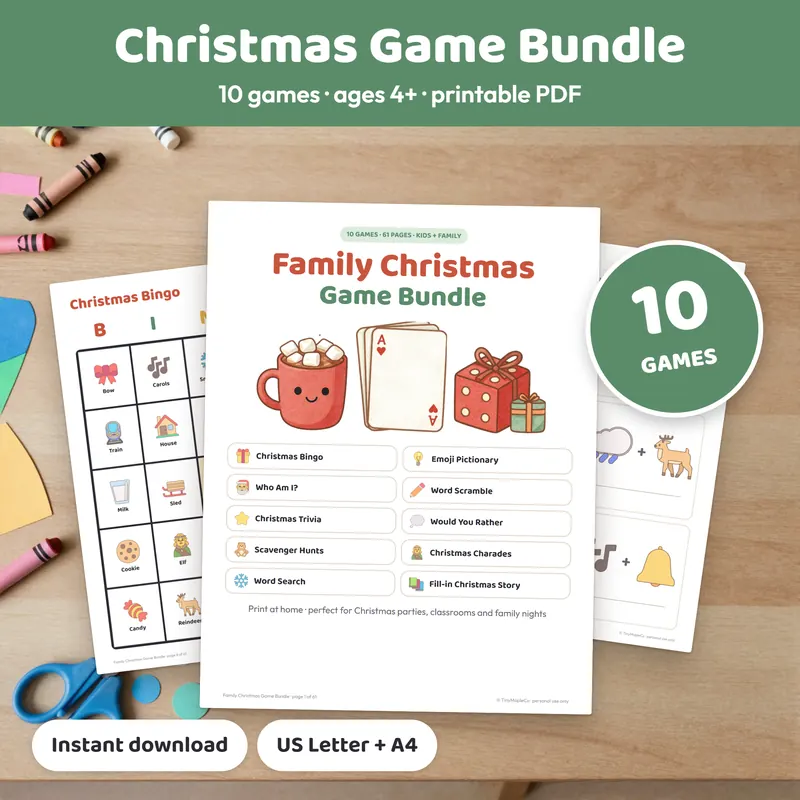
Family Christmas Games Bundle
61 pages · 10 games · 2–24 players · ages 4+ to grown-ups
- Christmas Bingo with 24 different boards + 30 calling cards
- Trivia (40 questions), Emoji Pictionary, Who Am I?, Charades, Would You Rather
- Scavenger hunt, word scramble, word search and a fill-in story; answer keys included
Instant download on Etsy · print at home
Frequently asked questions
How many people can play Christmas bingo?
Any number, as long as everyone has a different card. Twenty to twenty-five players works well with a set of 24 or more unique boards.
Can preschoolers play bingo?
Yes, with picture cards. Children ages 3–4 can match pictures with a grown-up helping; from about 5 they can usually play alone.
What can we use as bingo markers?
Paper squares, buttons, coins or small erasers for older kids. For young children, use larger markers such as bottle caps, or let them color the square with a crayon.
How long does a game of bingo take?
A single line game takes about 5–10 minutes. A full-card (blackout) game can take 15–20 minutes.