Christmas
24 Kindness Advent Calendar Ideas for Kids
A kindness advent calendar swaps the daily chocolate for a small kind act: a drawing for a neighbor, a thank-you note for the bus driver, a toy for donation. The best ones mix acts at home, for neighbors and for the wider community, keep each act under 15 minutes, and leave room for kids to notice how it felt.
Below are 24 ideas I would actually put in a calendar, grouped so you can mix them. Most cost nothing.
Kindness at home (ages 3 and up)
- Make someone’s bed as a surprise.
- Set the table for dinner, including folded napkins.
- Write or draw a “thank you” for a family member and hide it in their shoe or coat pocket.
- Let someone else choose the bedtime story or the movie tonight.
- Help with laundry: matching socks is a perfect job for 3–5 year olds.
- Make a compliment jar: each person writes or dictates one nice thing about everyone else.
- Call or video-call a grandparent and ask them a question about when they were little.
- Tidy a shared space (the shoe pile, the toy shelf) without being asked.
Kindness for neighbors and friends
- Draw a picture for a neighbor and leave it in their mailbox (with a grown-up).
- Make a “Happy holidays” sign for the window facing the street.
- Bake or assemble a simple treat for a neighbor. Ask about allergies first, or give a non-food card instead.
- Give a thank-you card to a teacher or child care worker before the break.
- Invite a friend to play who often plays alone.
- Share a toy or game with a sibling or cousin for a whole afternoon.
- Leave a kind sidewalk chalk message (if the weather allows) near your front door.
- Write a note for the mail carrier or delivery driver and tape it to the mailbox.
Kindness in the community (ages 5 and up, with a grown-up)
- Choose one toy in good condition to donate. Let the child pick and help drop it off.
- Pick up litter at a park, with gloves and a grown-up checking what is safe to touch.
- Make cards for a care home or hospital. Call first; many have rules about what they can accept.
- Donate food to a food bank. Older kids can read the list of most-needed items and shop for them.
- Fill the bird feeder or make a simple seed feeder for wild birds.
- Thank a community helper: a librarian, a crossing guard, a nurse at the clinic.
- Put coins in a charity box together, and talk about what the charity does.
- Plan a kindness for Christmas Eve: a voice message for someone spending the holiday alone, or a card for a relative far away.
How to set it up
You can turn this list into a calendar in about 30 minutes:
- Choose 24 acts that fit your December. Put the ones that need planning (donations, care home cards) on weekends.
- Write each act on a slip of paper or a card. For non-readers, add a quick drawing.
- Put them in numbered envelopes, a box with 24 compartments, or the links of a countdown paper chain.
- Check the week ahead on Sunday night. Swap any act that does not fit the coming days.
- Keep a kindness tracker on the fridge: a star or sticker for each act done.
If you would rather print than write, our Christmas Activity Pack includes a 24-day kindness calendar (December 1–24) alongside mazes and coloring pages, and the Advent Activity Cards set has 24 activity cards plus blank cards where you can write your own kind acts.
Make it feel real, not like homework
- Talk about it after. “How did Mrs. Lee look when she saw your drawing?” One question is enough.
- Let the child suggest acts. By the second week, many kids have ideas. Swap one of yours for one of theirs.
- Do it with them. Kindness is learned by watching. Doing the act together is the lesson.
- Avoid big rewards. A sticker on the tracker is fine; turning kindness into a prize system tends to change why kids do it.
- Keep it small on busy days. “Say thank you to the bus driver” counts.
For younger kids (ages 3–4)
Choose acts with a clear, visible result: making a card, feeding birds, setting the table, giving a toy. Abstract ideas such as “be patient with your sister” are hard for this age to act on. Read the act aloud in the morning and do it together before lunch so it does not hang over the day.
For older kids (ages 8–10)
Give them ownership. They can plan one community act per week, write the notes themselves, and keep a short December journal: what they did, who it was for, and one sentence on how it went.
Mixing kindness with fun
A full calendar of kind acts can feel heavy for some kids. Many families alternate: kindness on weekdays, a fun activity (cocoa night, a Christmas movie, a winter walk) on weekends. My advent calendar activity ideas has 24 fun, screen-free options to mix in, and a free 2-page sample with the first two activity cards and a countdown poster.
Small and regular beats big and rare. Twenty-four little acts add up to a December your kids will remember for the right reasons.
Printables that go with this post
These are from my shop on Etsy, where you see the price in your local currency.
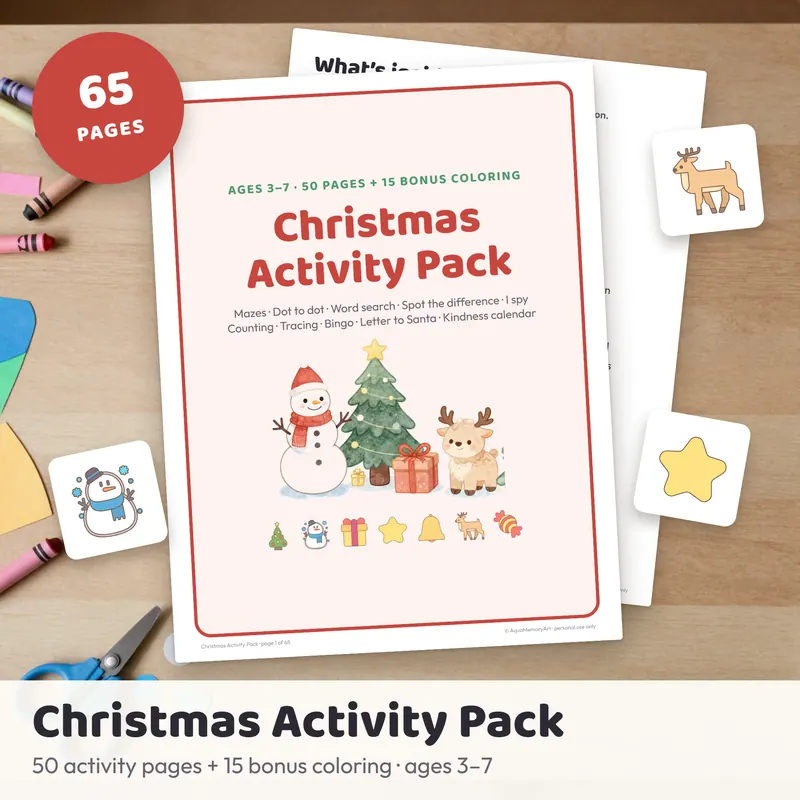
Christmas Activity Pack for Kids
65 pages (50 activity + 15 coloring) · ages 3–7 · US Letter + A4 PDF
- 4 mazes, 4 dot-to-dots, 3 word searches and spot-the-difference pages
- Letter to Santa, wish list and a 24-day kindness calendar
- Paper snowflake template, countdown paper chain and 3 bingo boards
Instant download on Etsy · print at home
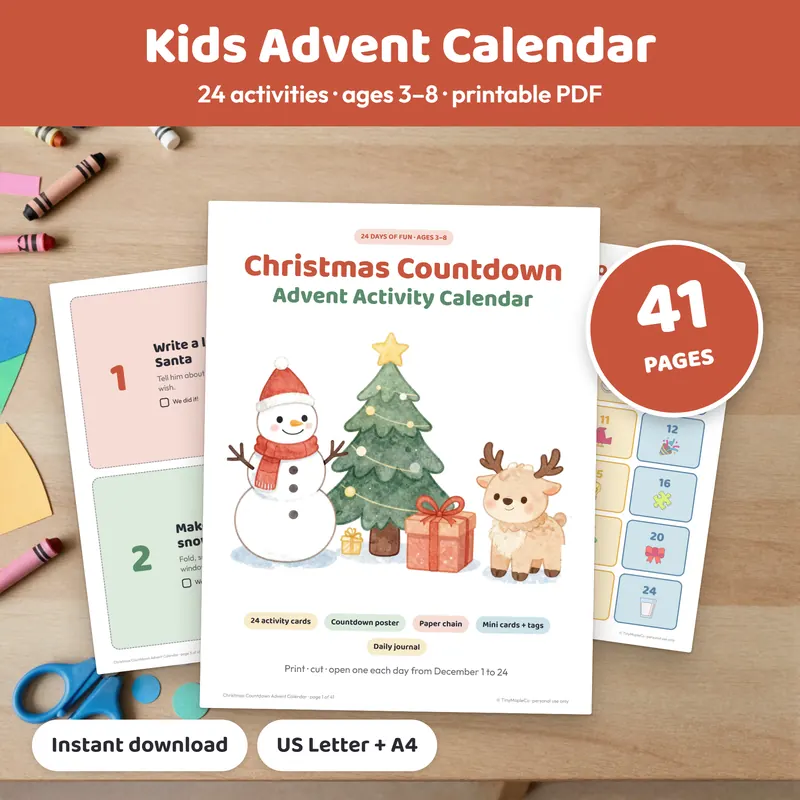
Christmas Advent Calendar Activity Cards
41 pages · 24 activity cards · ages 3–8 · US Letter + A4 PDF
- 24 big activity cards + 24 mini cards to hide in envelopes, bags or boxes
- 6 blank “make your own” cards and number tags 1–24
- Countdown poster, tree tracker, paper chain strips and a 4-page December journal
Instant download on Etsy · print at home
Frequently asked questions
What is a kindness advent calendar?
It is a December countdown where each day reveals a small kind act instead of (or as well as) a treat: drawing a card for a neighbor, helping set the table, donating a toy.
What age is a kindness calendar good for?
From about age 3 with lots of help. Ages 5–10 can do most acts with little support and start suggesting their own.
What if we miss a day?
Skip it or double up on the weekend. The point is the habit and the conversation, not a perfect record.
Do kindness acts have to cost money?
No. Most of the ideas on this list are free: notes, help, time and attention.