Learning at home
Fine Motor Activities With Household Items (Ages 2–6)
You do not need special toys for fine motor practice. Clothespins, painter’s tape, kitchen tongs, a muffin tin, paper and dry pasta cover most of what children ages 2–6 need: pinching, grasping, twisting, tearing and cutting. Keep sessions to about 10 minutes, pick activities that match your child’s age, and watch small pieces closely with under-3s.
Below are 18 activities sorted by the main skill they build, with rough ages. Ages are guides, not rules.
Pinching (the pincer grasp)
The pincer grasp, thumb and index finger working together, is what children later use to hold a pencil.
- Clothespins on a box edge (ages 3+). Clip spring clothespins around the rim of a shoebox. Harder than it looks for small hands.
- Pom-poms into an ice cube tray (ages 2+, large pom-poms only). Fingers first, then with kitchen tongs.
- Stickers (ages 2+). Peeling a sticker off the sheet is great pinch practice. Lift the corner for toddlers.
- Pick up cereal pieces (ages 2+). One by one into a cup. A snack and a skill.
- Pull painter’s tape off a table (ages 2+). Stick strips loosely; pulling them up strengthens fingers.
Grasping and hand strength
- Squeeze a sponge (ages 2+). Two bowls, one with water. Soak, carry, squeeze. Do it in the bath or on a towel.
- Play-dough (ages 2+). Roll snakes, squash balls, poke holes with a pencil. Homemade or store-bought.
- Tongs transfer (ages 3+). Move cotton balls from one bowl to another with kitchen tongs or salad servers.
- Spray bottle (ages 3+). Water the plants or “clean” a window. A small spray bottle builds the grip used for scissors.
Twisting and turning
- Open and close jars (ages 2+). Gather a few clean plastic jars with lids of different sizes; mix them up, match and screw on.
- Nuts and bolts (ages 4+). Large plastic ones, or big ones from a toolbox with supervision.
- Twist-off bottle caps on empty bottles (ages 3+). Caps are small; watch under-3s.
Tearing, folding and cutting
- Tear paper into strips (ages 2+). Old magazines or junk mail. Tearing uses both hands in different roles.
- Crumple paper balls (ages 2+) and throw them into a basket.
- Snip straws or paper strips (ages 3+). Child-safe scissors, short snips. Straws are easier than paper because they are stiff.
- Cut along a straight line (ages 4+). Draw thick lines on scrap paper; then wavy lines; then zigzags.
Threading and lacing
- Thread dry pasta onto a shoelace (ages 3+). Use large tube pasta such as rigatoni. Tie a knot at one end.
- Lacing through a colander (ages 2+). Push pipe cleaners into the holes of an upside-down colander.
Matching activities to age
| Age | Good starting activities |
|---|---|
| 2–3 | Stickers, tape pull, play-dough, crumpling paper, pipe cleaners in a colander |
| 3–4 | Clothespins, tongs, pasta threading, snipping straws, jars and lids |
| 4–6 | Cutting lines, nuts and bolts, folding paper, tracing then coloring inside shapes |
If an activity is frustrating, step back to an easier one. A 3 year old who cannot squeeze a clothespin yet can strengthen their hand with play-dough first.
Safety notes
- Choking: pom-poms, cereal, pasta, caps and small nuts and bolts can be choking hazards for children under 3, or older children who still mouth objects. Use large items and stay close. The AAP’s choking prevention page lists common risks.
- Water play: stay within reach whenever there is water in a bowl or tub, even a small amount.
- Scissors: child-safe scissors only, at the table, with a grown-up.
- Pipe cleaners: check the ends; trim or fold any sharp wire tips.
How fine motor connects to paper activities
These hands-on activities build the strength and control that paper tasks need later. A child who has squeezed, pinched and snipped for months usually finds holding a crayon, tracing a line and cutting along a dashed edge much easier.
For toddlers, laminated busy book pages are a natural next step: pulling hook-and-loop pieces off and pressing them on is pinch-and-press practice. My toddler busy book guide explains how to assemble a binder and has a free 2-page sample (an ornament color sort mat and pieces).
For 4–6 year olds, tracing and cutting pages give fine motor a purpose. My kindergarten Christmas worksheets guide explains which skills preschoolers and kindergarteners usually practice, and it offers a free 3-page sample. Our Christmas Worksheets PreK + K set includes cutting practice pages, a pre-writing line tracing page and letter tracing, which fits nicely after a few weeks of the activities above.
Make a fine motor basket
Put five items in a basket by the kitchen table: a clothespin set, a lump of play-dough, tongs and pom-poms, a pair of child scissors with scrap paper, and a shoelace with pasta. Swap one item a week. Having it ready makes a 10-minute session easy to start while dinner cooks.
A sample 10-minute session (age 3)
- 2 minutes: pull painter’s tape strips off the table.
- 3 minutes: pick up pom-poms with fingers, then with tongs, into an ice cube tray.
- 3 minutes: squeeze and roll play-dough snakes.
- 2 minutes: tidy up together, putting each item back in the basket.
Stop early if your child loses interest. Tomorrow is another chance.
Ordinary household items, short sessions and a grown-up nearby: that is all fine motor practice needs.
Printables that go with this post
These are from my shop on Etsy, where you see the price in your local currency.
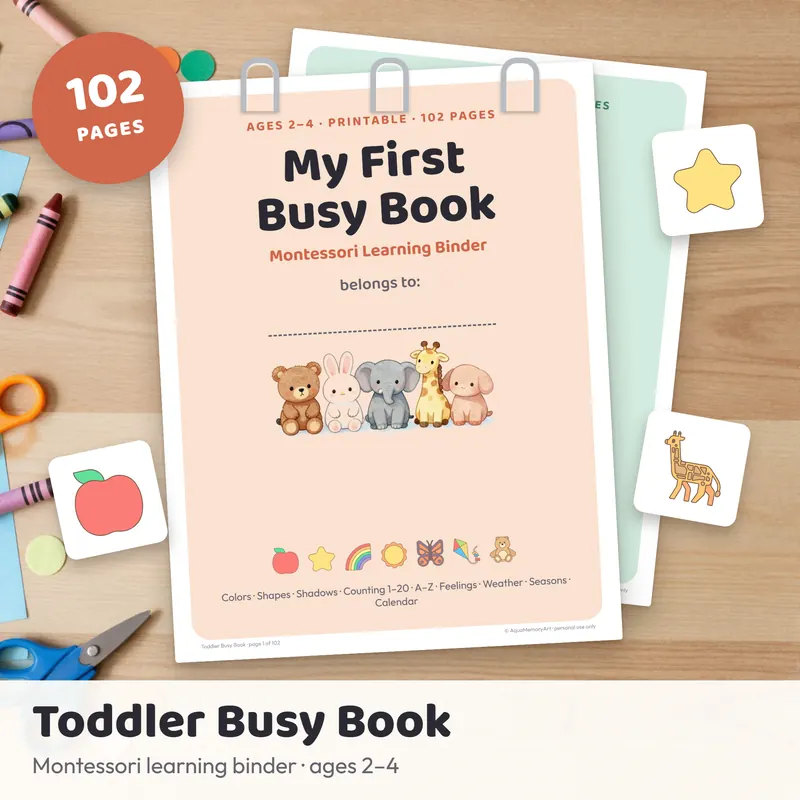
Toddler Busy Book Printable (Montessori Learning Binder)
102 pages · ages 2–4 · US Letter + A4 PDF
- Color, shape and shadow matching mats with picture cards
- Count 1–10 ten-frame mats, numbers 1–20 and an A–Z page for every letter
- Weather, calendar, feelings, seasons and sorting activities
Instant download on Etsy · print at home
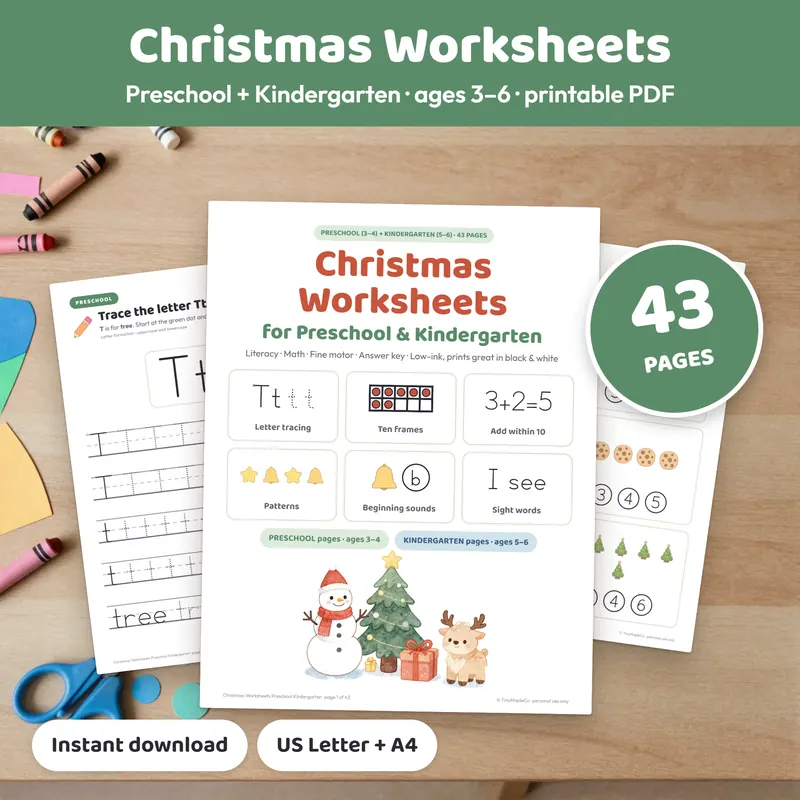
Christmas Worksheets for Preschool + Kindergarten
43 pages · Preschool (3–4) + Kindergarten (5–6) levels · US Letter + A4
- Letter tracing, beginning sounds, CVC words and sight words
- Counting, ten frames, number tracing 1–20 and adding within 10
- Cutting practice, mazes and a 2-page answer key
Instant download on Etsy · print at home
Frequently asked questions
What are fine motor skills?
They are the small movements of the hands and fingers: pinching, grasping, twisting, cutting, and the hand-eye coordination that later supports holding a pencil, buttoning and using cutlery.
How often should kids do fine motor activities?
A few short sessions a week is plenty alongside ordinary play. Ten minutes at a time is a good length for preschoolers.
When should I worry about fine motor skills?
Children develop at different rates. If you have concerns, for example your child avoids using their hands or seems to struggle much more than peers, talk to your pediatrician, who can refer you to an occupational therapist if needed.