Routines
Morning Routine for Kids Who Dawdle: 10 Fixes
Most kids who dawdle in the morning are not being difficult. They are tired, distracted, unsure what comes next, or unable to feel how long five minutes is. The fixes that work are practical: prepare the night before, show the steps as pictures, cut decisions, make time visible with a timer or song, and put something fun at the end.
Here are 10 changes, roughly in order of how much difference they tend to make.
1. Move half the morning to the night before
The fastest morning is the one with fewer steps. After dinner or before bath:
- Lay out clothes, including socks and underwear
- Pack the school bag and put it by the door
- Put shoes and coat in the same spot
- Set out the breakfast bowls and spoons
That alone can remove 10 minutes of searching and arguing.
2. Show the steps as pictures
Children ages 3–8 do better with a short picture list than with spoken reminders. A chart with 5–8 steps (toilet, dress, breakfast, teeth, shoes, coat) lets them check their own progress. When you say “What’s next on your chart?” instead of “Brush your teeth!” for the third time, you stop being the reminder machine.
My morning routine chart guide covers which steps to include by age and how to introduce a chart, with a free 2-page sample (a morning flip chart and a sheet of picture cards).
3. Reduce decisions
Choices take time for small children. Give two options at most:
- “The red shirt or the blue one?” (chosen the night before)
- “Toast or cereal?”
- Same breakfast on school days, different on weekends
4. Make time visible
- Visual timer: the kind where a colored disc shrinks as time passes.
- One song per step: “Get dressed before this song ends.” A playlist of 5–6 songs becomes the morning clock.
- “Beat the timer” game: set 5 minutes for dressing and see if they finish first.
Keep it playful. If the timer becomes a threat, it stops working.
5. Get dressed before breakfast
Breakfast is where mornings stall: kids get comfortable, chat and slow down. Dressing first means the slowest part happens when they are most alert, and the reward (eating) comes after.
6. Remove the distractions
- No screens before everything is done. If screens are on, mornings slow down for almost every child.
- Toys put away in the dressing area. A single toy on the floor can take 15 minutes.
- Separate siblings who distract each other, if you can: one dresses in the bedroom, one in the bathroom.
7. Stay close for the hardest step
Most kids have one step where they always stall: socks, teeth, finding the second shoe. Instead of calling from the kitchen, go stand with them for that one step. It takes less time than shouting reminders.
8. Put a fun step last
Make the final step something your child wants: free play, a book, feeding the fish, a few minutes of drawing. If everything is done, there is time for it. If not, it gets shorter. It is a natural consequence, not a punishment.
9. Wake up a bit earlier, consistently
If the routine needs 45 minutes and you have 35, no chart will fix it. Try moving wake-up 10–15 minutes earlier, together with an earlier bedtime so your child is not short on sleep. The AAP’s page on healthy sleep habits lists how many hours children need, and a tired child is a slow child.
10. Use the same words each morning
Pick short, calm phrases and keep them the same:
- “What does your chart say?”
- “Two more steps, then free time.”
- “Shoes, then coat, then door.”
Repetition removes the debate. You are not arguing; you are pointing to the routine.
A sample 40-minute school morning (ages 5–7)
| Minutes | Step |
|---|---|
| 0–5 | Wake up, toilet, wash hands |
| 5–12 | Get dressed (clothes laid out) |
| 12–25 | Breakfast |
| 25–30 | Brush teeth, hair |
| 30–35 | Shoes, coat, bag |
| 35–40 | Free time if everything is done |
For ages 3–4, allow more time and fewer steps, and do most steps alongside them.
When it might be something else
If your child seems exhausted every morning, very anxious about school, or the struggle is new and sudden, it is worth looking beyond routine. Talk with their teacher, and with your pediatrician if you are concerned about sleep, mood or health.
A chart they can flip
If a static chart stops working after a few weeks, a chart with something to physically do often brings it back. Our Kids Routine Flip Chart has a “DONE!” flap that kids flip over for each step, plus picture cards to build your own routine; mornings are one of five charts in the set. A hand-drawn chart with sticky notes your child moves from “to do” to “done” works on the same idea.
Give it two weeks
New routines take time. Expect the first week to be slower while your child learns the steps. By week two, many families find they are repeating themselves far less, and the morning feels calmer even if it is not much faster.
Prep the night before, pictures instead of reminders, a fun last step. Those three alone change most mornings.
Printables that go with this post
These are from my shop on Etsy, where you see the price in your local currency.
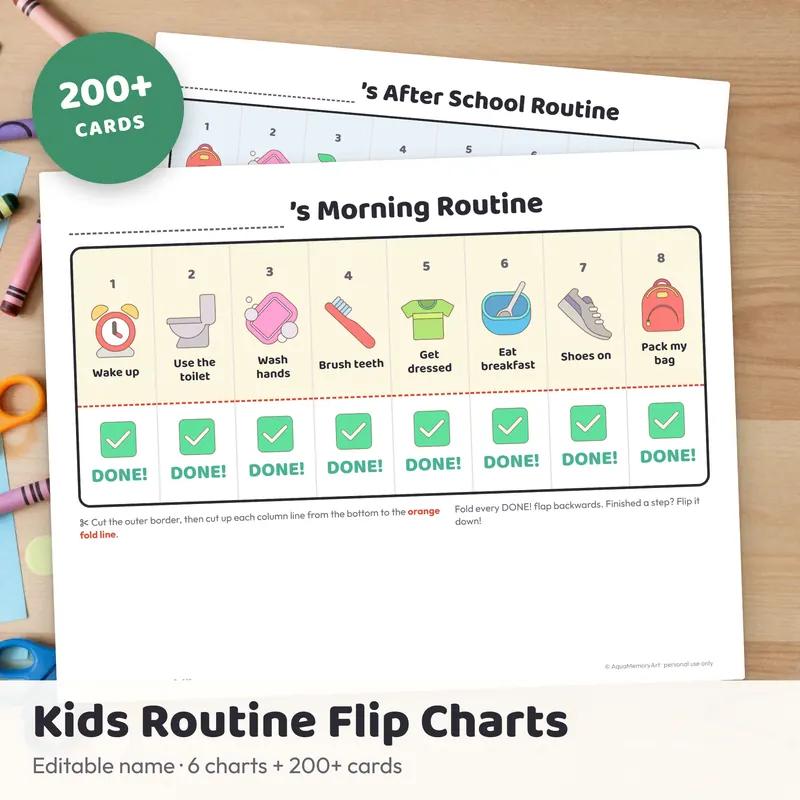
Kids Routine Flip Chart Bundle
5 flip charts + 1 blank · 216 picture cards · color + black & white
- Morning, After School, Bedtime, Chore and Weekend charts, 8 steps each
- Every step has a “DONE!” flap kids flip over when they finish
- Fillable name field; color and black & white sets in US Letter and A4
Instant download on Etsy · print at home
Frequently asked questions
Why does my child dawdle in the morning?
Common reasons include tiredness, distractions (toys, screens, siblings), too many decisions, unclear steps, and simply having no sense of time yet. Young children also move at a slower pace than adults.
Do timers help kids get ready faster?
For many kids, yes. A visual timer or a short song for each step makes time visible. Use them as a game, not a threat.
Should I reward my child for getting ready on time?
Built-in rewards often work better than prizes: if everything is done, there is time to play, read or feed the pet before leaving.