Routines
Chores for 4 Year Olds: 25 Real Jobs They Can Do
Four year olds can do real chores: make their bed (roughly), put toys and clothes away, set their place at the table, feed a pet with help, wipe spills, sort socks and water plants. Start with two or three daily jobs, teach each one by doing it together first, show them on a picture chart, and praise effort rather than perfection.
The American Academy of Pediatrics describes chores as a way for children to learn responsibility and contribute to the family. At four, the result will be wobbly. That is fine.
25 chores for 4 year olds
In their room
- Pull the duvet or blanket up to “make” the bed
- Put toys back in labeled bins
- Put dirty clothes in the laundry basket
- Choose and lay out clothes for tomorrow (from two options)
- Put books back on the shelf
- Open the curtains in the morning
In the kitchen
- Set their own place: plate, cup, cutlery (no sharp knives)
- Carry their plate to the counter after meals
- Wipe the table with a damp cloth
- Put unbreakable cups and plastic containers away
- Help unload cutlery (not knives) from the dishwasher
- Wash fruit and vegetables in a bowl of water
- Put napkins on the table
Laundry
- Sort socks into pairs
- Sort laundry by color (whites, darks)
- Fold washcloths and small towels
- Put their own folded clothes in a drawer
Around the house
- Water plants with a small watering can
- Dust low surfaces with a sock on their hand
- Wipe spills with a towel
- Line up shoes by the door
- Help put groceries away (light, unbreakable items)
- Carry recycling to the bin (paper and plastic only)
Pets and outdoors
- Help feed a pet (you measure, they pour)
- Gather leaves or sticks in the garden
Chores to save for later
- Anything with cleaning chemicals. Keep products locked away and in their original containers. Plain water and a cloth are enough for a 4 year old.
- Sharp knives, the stove, the oven and hot water.
- Glass and breakables.
- Heavy lifting or climbing on chairs to reach shelves.
How to teach a chore (4 steps)
- Do it in front of them and say each step aloud: “First I pull the blanket up. Then I put the pillow on top.”
- Do it together for a few days.
- Let them do it while you watch, with a hint if they stall.
- Let them do it alone, then check in.
Break jobs into very small steps. “Clean your room” is too big. “Put all the cars in the blue bin” is just right.
Lower the standard (really)
A bed made by a 4 year old will be lumpy. Socks will be mismatched. If you redo the job in front of them, they learn their effort does not count. Fix it later if you must, or leave it.
Use a picture chart
Four year olds cannot read a list, but they can follow pictures. A chart with their two or three daily jobs, next to the morning or evening steps, makes chores part of the routine rather than a request. You point to the chart; the chart asks.
My morning routine chart guide explains how to build a picture chart that works, with a free 2-page sample (a morning flip chart and a sheet of picture cards).
A sample weekly chart
| Day | Daily jobs | Extra job |
|---|---|---|
| Mon | Make bed, set place, toys away | Water plants |
| Tue | Make bed, set place, toys away | Sort socks |
| Wed | Make bed, set place, toys away | Wipe the table |
| Thu | Make bed, set place, toys away | Feed the pet |
| Fri | Make bed, set place, toys away | Line up shoes |
| Sat | Make bed, toys away | Help with groceries |
| Sun | Make bed, toys away | Rest day |
Praise, not payment
At four, most children are motivated by being included and praised for helping. Specific praise works best: “You put every car in the bin. That was a big job.” A sticker or a check on the chart is a fine visual extra. Many families wait until children are older before linking any chores to an allowance.
When they refuse
- Make it smaller: “Just the cars, I will do the blocks.”
- Do it together and make it a race or a song.
- Offer a choice of jobs: “Do you want to water plants or wipe the table?”
- Stay consistent: the chore still happens, but without a battle.
A chart with chores included
Our Kids Routine Flip Chart includes a Chore Chart alongside morning, after-school, bedtime and weekend charts, plus a large set of illustrated picture cards to swap in the jobs that fit your child, and a “DONE!” flap for each step. A hand-drawn chart with stickers works the same way.
Tools that help small hands
- A small dustpan and brush
- A spray bottle filled only with water
- A step stool with a wide base, used with a grown-up nearby
- Low hooks for coats and bags
- Labeled bins with a picture of what goes inside
When the tools fit their size, 4 year olds can do much more on their own, and they are far more willing to try.
Small jobs, picture steps, praise for trying. Four year olds can be real helpers, and they are usually proud to be.
Printables that go with this post
These are from my shop on Etsy, where you see the price in your local currency.
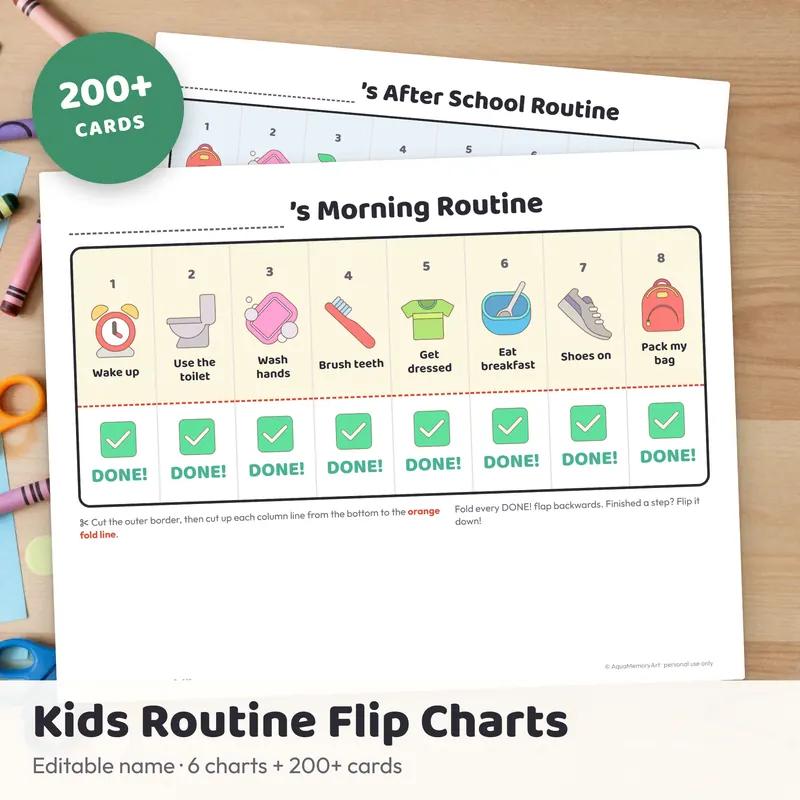
Kids Routine Flip Chart Bundle
5 flip charts + 1 blank · 216 picture cards · color + black & white
- Morning, After School, Bedtime, Chore and Weekend charts, 8 steps each
- Every step has a “DONE!” flap kids flip over when they finish
- Fillable name field; color and black & white sets in US Letter and A4
Instant download on Etsy · print at home
Frequently asked questions
How many chores should a 4 year old have?
Two or three small daily jobs, such as making their bed and setting their place at the table, plus one or two helping jobs during the week, is plenty.
Should I pay my 4 year old for chores?
At this age, most families keep chores as part of being in the family, with praise and a sticker or a check on a chart. Allowance can come later if you choose.
What if my child refuses?
Make the job smaller, do it together, and use a picture chart so it is the routine asking, not you. Keep it light and consistent.