Routines
Bedtime Routine for Preschoolers: Steps, Timing, Tips
A good bedtime routine for a preschooler is the same short sequence each night, about 20–40 minutes long: a snack if needed, bath or wash, pajamas, teeth, toilet, one or two books, a song or a short chat, then lights out. Screens go off at least an hour before bed, and the steps are shown on a picture chart so your child knows what comes next.
Routine matters more than the exact steps. Preschoolers relax when they know what is coming.
How much sleep do preschoolers need?
The AAP supports guidelines of 10 to 13 hours of sleep in 24 hours for children ages 3–5, including naps. Its page on healthy sleep habits also recommends a consistent routine, regular sleep and wake times (including weekends), and turning off screens at least 60 minutes before bed.
To find a bedtime, count back from wake-up time. If your 4 year old wakes at 6:45 am and no longer naps, a bedtime between about 7:00 and 7:45 pm gives them roughly 11 to 12 hours.
A 30-minute routine, step by step
| Time before lights out | Step |
|---|---|
| 60 minutes | Screens off, calmer play |
| 30 minutes | Small snack if needed (before teeth) |
| 25 minutes | Bath or wash face and hands |
| 18 minutes | Pajamas |
| 14 minutes | Brush teeth |
| 11 minutes | Toilet, wash hands, water sip |
| 9 minutes | Books (one or two, agreed in advance) |
| 2 minutes | Song, cuddle, “one good thing about today” |
| 0 | Lights out, night light if used |
Not every family bathes every night; on non-bath nights, a quick wash takes its place.
Why a picture chart helps
Three to five year olds cannot read a list, but they can follow pictures. A chart with five to seven bedtime steps lets your child check what comes next and move a marker or flip a card when a step is done. It also removes the nightly debate: you point to the chart instead of repeating instructions.
The same idea works for mornings. My morning routine chart guide explains how to choose steps, introduce a chart and keep it working, and it has a free 2-page sample (a morning flip chart and picture cards). The same approach applies at bedtime.
Tips for common bedtime problems
“One more book!”
Agree on the number of books before you start, and let your child choose them while still in the bedroom. When the agreed books are finished, the reading part is over. Keep the same number on most nights.
“I need water / the toilet / another hug”
Build each request into the routine: water before teeth, toilet as a step, a goodnight hug at the end. Then, if they ask again, you can calmly say, “We already did that. It’s sleep time now.”
Getting out of bed
Walk them back without a long conversation. Same words, same calm tone: “It’s sleep time. I love you. Goodnight.” Consistency over a week or two usually works better than any single trick.
Fear of the dark
A dim night light, a favorite soft toy and a short chat about what feels scary can help. Avoid scary stories or shows near bedtime.
Bedtime battles over pajamas or teeth
Offer small choices: “Dino pajamas or star pajamas?” “Brush teeth first or put pajamas on first?” Choices give a sense of control without changing the routine.
Building in wind-down time
The hour before bed sets the tone. Calmer activities work better than chasing games:
- Puzzles or building blocks
- Coloring
- Quiet pretend play
- A short tidy-up together, which is also a signal that the day is ending
Weekends and holidays
The AAP advises keeping sleep and wake times regular, including weekends. Small shifts are fine. During the holidays, try to keep the order of the routine even if bedtime is later: bath, pajamas, teeth, books, bed. The familiar sequence helps preschoolers settle in a new place, such as a grandparent’s house.
When to talk to your pediatrician
Ask your child’s doctor if your child snores loudly, seems to stop breathing during sleep, is very sleepy during the day despite enough sleep, has frequent night terrors, or if bedtime struggles are affecting the whole family’s sleep.
A chart that grows with them
If you want a ready-made chart, our Kids Routine Flip Chart includes a Bedtime chart with 8 steps, each with a “DONE!” flap to flip, and picture cards to build your own sequence. A hand-drawn chart with five pictures on the bedroom door works on the same principle.
Getting started tonight
- Decide your bedtime by counting back from wake-up.
- Choose five to seven steps.
- Draw or print them as pictures.
- Walk your child through the chart in daylight first.
- Keep the order the same for two weeks before changing anything.
Bedtime when there are two kids
Siblings close in age can share most of the routine: bath, pajamas and teeth together, then one shared book. If bedtimes differ, the younger child goes first while the older one has a quiet activity, such as a book or a puzzle in another room. Give each child a few minutes alone with a grown-up at the end, even if it is just a short chat. Many kids look forward to that part more than the story.
Same steps, same order, screens off early. That is a bedtime routine a preschooler can relax into.
Printables that go with this post
These are from my shop on Etsy, where you see the price in your local currency.
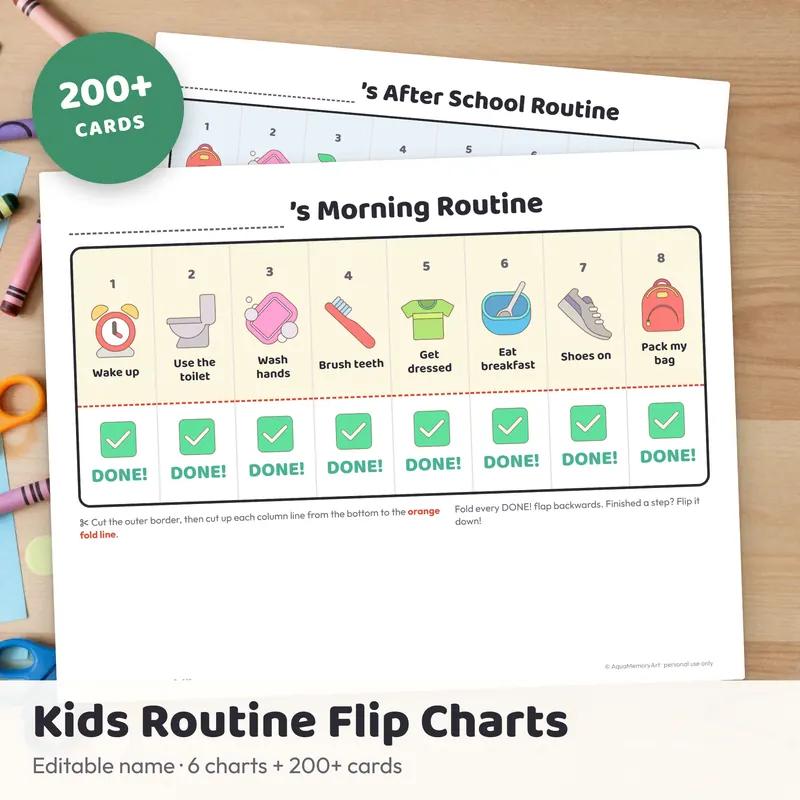
Kids Routine Flip Chart Bundle
5 flip charts + 1 blank · 216 picture cards · color + black & white
- Morning, After School, Bedtime, Chore and Weekend charts, 8 steps each
- Every step has a “DONE!” flap kids flip over when they finish
- Fillable name field; color and black & white sets in US Letter and A4
Instant download on Etsy · print at home
Frequently asked questions
How much sleep does a preschooler need?
The American Academy of Pediatrics supports guidelines of 10 to 13 hours of sleep per 24 hours for children ages 3 to 5, including naps.
How long should a bedtime routine take?
About 20–40 minutes is typical. Long enough to wind down, short enough to keep it consistent on busy nights.
What should I do when my child keeps getting out of bed?
Return them calmly with as few words as possible, every time. Make sure needs such as water and the toilet are part of the routine, so there are fewer reasons to get up.